
The New World Order
Mark Carney’s Davos Declaration: America’s Hegemonic Era Is Over

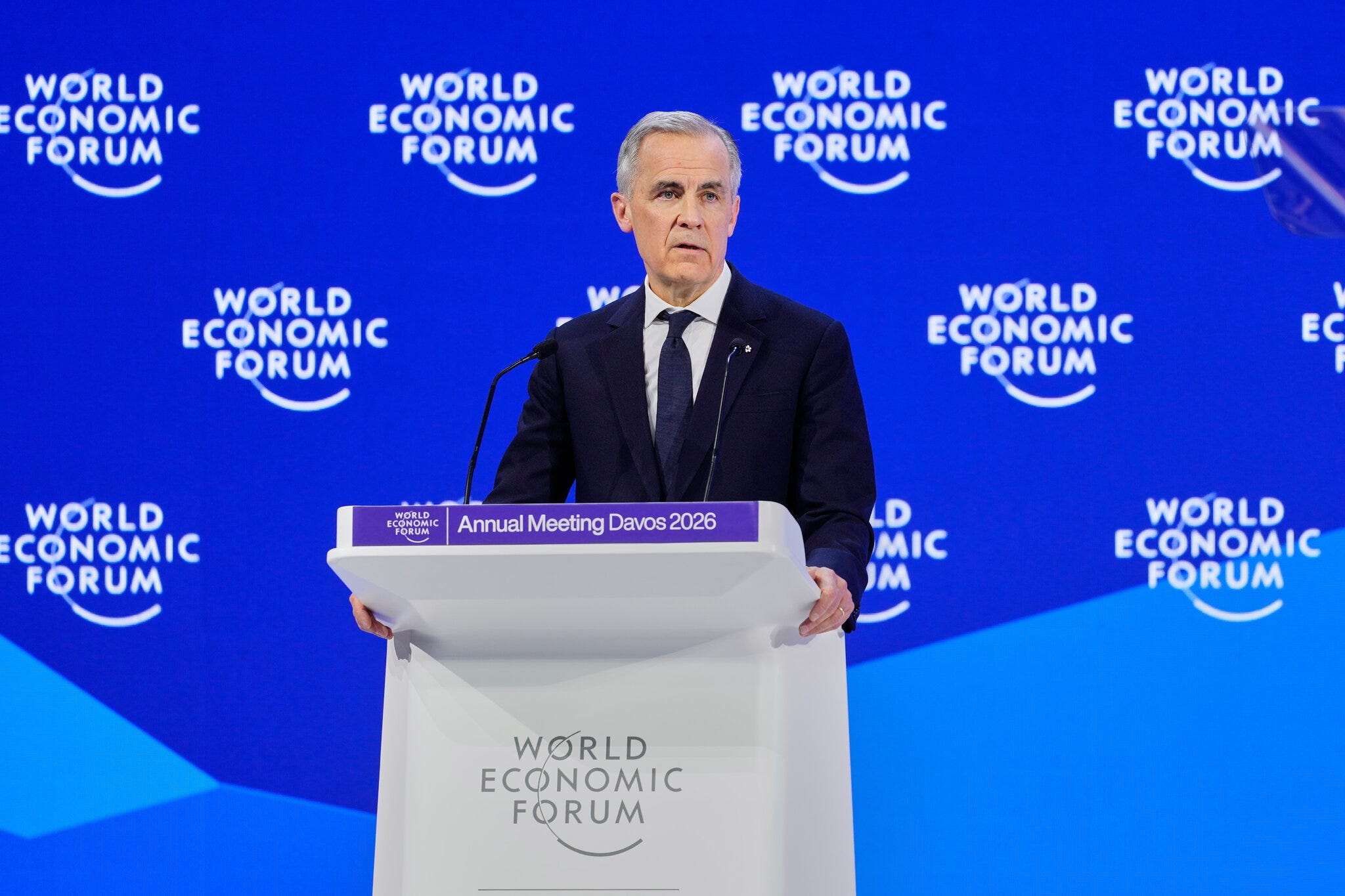
The world just witnessed an extraordinary moment. No different than the fall of the wall or the fall of Berlin and Hitlers demise.
The world just heard the first world leader - a westerner from Canada - declare that multilateralism is the new architecture that will govern the globe. America is no longer the sole superpower.
On Tuesday, January 20, 2026—the very day Donald Trump was inaugurated for his second term—Canadian Prime Minister Mark Carney stood before the World Economic Forum in Davos and delivered what may be remembered as the obituary for the American-led global order. Not with mourning, but with the cold clarity of a central banker calling time on a failed investment.
“The old order is not coming back,” Carney declared. “We should not mourn it. Nostalgia is not a strategy.”
This wasn’t diplomatic hedging.
This was a funeral announcement.
The End of American Exceptionalism
For eight decades, the world operated under what we politely called the “rules-based international order”—a system built on American hegemonic power that promised open sea lanes, stable financial markets, collective security, and frameworks for resolving disputes. It was never as fair or as functional as advertised. The strongest nations exempted themselves when convenient. Trade rules were enforced asymmetrically. International law applied with varying rigor depending on who stood accused.
But as Carney put it, “This fiction was useful.” American hegemony provided genuine public goods. So middle powers like Canada participated in the rituals, placed the metaphorical sign in the window, and largely avoided calling out the gaps between rhetoric and reality.
That bargain, Carney announced, no longer works.
“We are in the midst of a rupture, not a transition,” he said, framing the current moment not as a temporary disruption but as a fundamental break in how power operates globally. Over the past two decades, crises in finance, health, energy, and geopolitics exposed the risks of extreme global integration. But more recently, something darker emerged: great powers began weaponizing that integration itself.
“Tariffs as leverage. Financial infrastructure as coercion. Supply chains as vulnerabilities to be exploited.”
He didn’t name Trump. He didn’t have to. Everyone in that room knew exactly which great power he meant—and it wasn’t China.
Living Within the Lie
Carney’s speech was structured around an extended metaphor drawn from Václav Havel’s essay “The Power of the Powerless.” Havel wrote about a Czech greengrocer under communist rule who displayed a sign reading “Workers of the world, unite!” The shopkeeper didn’t believe it. No one believed it. But everyone performed compliance to avoid trouble, to signal they were going along to get along.
The system persisted not through violence alone, but through the participation of ordinary people in rituals they privately knew to be false. Havel called this “living within a lie.”
For Carney, middle powers have been that greengrocer. For decades, they’ve participated in the fiction of the rules-based order, knowing it was partially false, knowing the powerful exempted themselves, knowing enforcement was asymmetric. But they went along because the alternative seemed worse.
“You cannot live within the lie of mutual benefit through integration when integration becomes the source of your subordination,” Carney said.
Translation: When the hegemon starts using the very systems designed for collective benefit as weapons of coercion, the jig is up. It’s time to take the sign down.
The Multipolar Reality
What Carney described isn’t just the end of American hegemony—it’s the collapse of hegemony itself as an organizing principle. The world isn’t transitioning to Chinese hegemony or some other single dominant power. Instead, we’re entering an era of multipolar great power rivalry where the strong do what they can and the weak suffer what they must.
The implications are profound and dangerous.
In this new world, middle powers face an existential choice: build fortresses and go it alone, or band together to create what Carney called a “third path.” Going it alone means developing “strategic autonomy” in energy, food, critical minerals, finance, and supply chains. It means countries that can’t feed themselves, fuel themselves, or defend themselves will have few options when the rules no longer protect them.
But Carney warned that a world of fortresses would be “poorer, more fragile, and less sustainable.”
The alternative—his prescription for survival—is what he termed “variable geometry”: different coalitions for different issues, based on common values and interests. Not the multilateralism of old, with its dying institutions like the WTO and UN, but pragmatic, issue-specific alliances that function as described rather than as advertised.
What Canada Is Actually Doing
Here’s where Carney moved from diagnosis to demonstration. Since taking office, his government has fundamentally reoriented Canadian foreign policy around this new reality.
The measures are striking:
∙ Doubling defense spending by decade’s end
∙ Signing twelve trade and security deals across four continents in six months
∙ Concluding strategic partnerships with China and Qatar
∙ Negotiating free trade agreements with India, ASEAN, Thailand, Philippines, and Mercosur
∙ Joining Europe’s defense procurement arrangements through SAFE
∙ Removing all federal barriers to interprovincial trade
∙ Fast-tracking a trillion dollars in domestic investment
This is what adaptation to the post-hegemonic world looks like: rapid diversification away from dependence on any single power, even your closest ally.
The message to Washington was unmistakable. On the very day Trump took office again, Carney stood with Greenland and Denmark against American territorial ambitions, reaffirmed Canada’s unwavering commitment to NATO’s Article 5, and announced that “Canada strongly opposes tariffs over Greenland.”
He also dropped this diplomatic grenade: “When we only negotiate bilaterally with a hegemon, we negotiate from weakness. We accept what is offered. We compete with each other to be the most accommodating. This is not sovereignty. It is the performance of sovereignty while accepting subordination.”
Read that again. The leader of America’s largest trading partner and closest ally just said bilateral negotiations with the United States amount to performing sovereignty while accepting subordination.
That’s not diplomacy. That’s a declaration of independence.
The Stakes for America
Americans need to understand what’s happening here. This isn’t some academic theory about international relations. This is the lived reality of how the world now perceives American power under Trump.
For decades, American hegemony rested on more than military might or economic muscle. It rested on legitimacy, on the provision of public goods, on at least the pretense of rules that applied to everyone. That legitimacy is collapsing—not because of Chinese propaganda or Russian disinformation, but because of American actions.
When Trump threatens to seize Greenland, imposes tariffs as blackmail, and treats allies like vassals to be bullied, he’s confirming Carney’s diagnosis that the hegemon has abandoned “even the pretense of rules and values for the unhindered pursuit of their power and interests.”
The consequence, as Carney warned, is predictable: “Hegemons cannot continually monetize their relationships. Allies will diversify to hedge against uncertainty. They’ll buy insurance, increase options, in order to rebuild sovereignty.”
This is already happening. Not in the future. Now.
America’s allies aren’t waiting for Trump to moderate or for Democrats to reclaim power in 2028. They’re actively building the infrastructure of a post-American global order. They’re creating trade blocs that exclude the United States. They’re developing defense arrangements that don’t depend on American security guarantees. They’re establishing financial systems that route around American infrastructure.
Carney even proposed “building a bridge between the Trans-Pacific Partnership and the European Union, which would create a new trading block of 1.5 billion people”—conspicuously without mentioning the United States at all.
What It Means for the World
The death of American hegemony doesn’t mean the end of American power. The United States will remain a great power with enormous military capacity, a huge domestic market, and significant global leverage. But great powers operating without the legitimacy that hegemony requires become just another player in a multipolar game—one that other powers will increasingly resist, route around, and balance against.
For the rest of the world, this creates both danger and opportunity.
The danger is obvious: a world of competing power blocs, of economic coercion, of military tension unconstrained by shared institutions or common rules. History suggests these conditions tend toward conflict.
But Carney articulated the opportunity: middle powers acting together can create genuine collective security and prosperity. Not by restoring the old order—that’s dead—but by building new institutions that actually function as described. By applying consistent standards to allies and rivals alike. By reducing vulnerability to coercion through economic strength and diplomatic diversification.
This is what he meant by “variable geometry”—coalitions of the willing on specific issues rather than universal institutions that powerful nations ignore when convenient.
On Ukraine: a core coalition of committed supporters rather than hollow UN resolutions.
On Arctic security: standing with Greenland and Denmark against American pressure.
On trade: building bridges between existing agreements to create new leverage.
On critical minerals: forming buyers’ clubs to diversify away from concentrated supply.
On AI: cooperating among democracies to avoid choosing between hegemons and hyperscalers.
The Path Forward
Carney closed his speech by returning to Havel’s greengrocer: “We are taking the sign out of the window.”
Middle powers are done pretending the rules-based order functions. They’re done staying silent about economic coercion from allies while condemning it from rivals. They’re done accepting subordination while performing sovereignty.
“The powerful have their power,” Carney said. “But we have something too—the capacity to stop pretending, to name reality, to build our strength at home, and to act together.”
This is the stakes moment for American power. Not a temporary setback or a negotiating tactic that can be reversed with the next election. This is structural change in how the world organizes itself.
The old order—America at the center, allies in orbit, adversaries excluded—is finished. The question isn’t whether that order can be restored. It can’t. The question is what comes next.
Carney offered a vision: a world where middle powers combine their strength, where legitimacy and rules still matter because coalitions of democracies choose to wield them together, where strategic autonomy doesn’t mean isolation but rather the foundation for principled foreign policy.
Whether that vision can be realized depends on whether middle powers can overcome their instinct to compete for favor with great powers and instead combine to create that third path.
But one thing is certain: The New World Order won’t be centered in Washington. And it won’t wait for American permission to be born. The greengrocer has taken down his sign. The question is whether anyone else will join him—or whether we’ll all just find ourselves on the menu.
See it. Name it. And answer with solidarity with creative solutions. I am exceptionally proud that the PM that decided to call this out and work toward answers is our northern neighbor. This gives me hope. I think that among the creative solutions will be coalitions emerging that depend less on nation states and more upon shared ideals. Such an excellent essay and explainer, Mike. Thank you!
Mexico elects a President that is also a scientist, Canada elects a PM with a PhD in economics, the US elects a morally bankrupt, adjudicated rapist. After the PMs speech, Airforce One develops a "minor electrical" issue- if you've ever flown, you will realize there is no such thing as a minor electrical issue at 30,000ft. One year down, three to go. Actually, I feel better about our chances than I did a year ago. The emperor has no clothes. Thank you Mike.