
On War and Peace
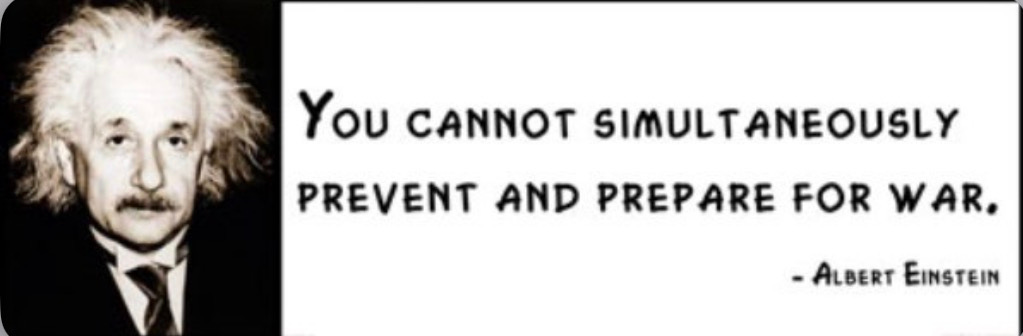
"You can not simultaneously prevent and prepare for war." - Albert Einstein

In the Spring of 1992 when the crisp air of winter hadn’t fully given way to the return of leaves, I met a beautiful young woman in the parking lot of the community college where we were both attending classes. Her name isn’t important for this essay but suffice it to say that after this chance meeting we went on to spend the early part of our college years together in a romantic relationship where I learned that opposites do indeed attract but don’t often last.
What broke the ice between us was a bumper sticker on her car: You can not simultaneously prevent and prepare for war.
As young adults raised in the shadow of the Cold War and Operation Desert Storm the dominant thought set in the cement of that era was that a strong powerful America, based on our military might, was what made for a peaceful planet. It wasn’t our warmongering of course, it was everyone else’s that was the problem.
You know…Peace through strength.
My worldview was heavily influenced through the zeitgeist of the Reagan years. Hers was clearly more pacifist - more Einstein than Reagan. There were many passionate discussions about the nature of mankind: Are we in a state of peace interrupted by war or a state of war interrupted by peace? Is man inherently good? What system of government allows for that nature to be most fulfilled?
You know, the kind of elementary college discussions that make us both smile wryly at their innocence and yet wish we were back there again to experience them for the first time.
For all the political philosophers, politicians and statesman I looked to for answers to these questions, it has never escaped me that my girlfriend looked to a physicist for hers.
There is a particular kind of tragedy reserved for the man who builds the fire and then warns the world about burning. Albert Einstein spent the last decade of his life in a state of moral reckoning that few of us will ever be asked to face. His understanding of physics and mathematical equations had cracked open the universe. His letter to Roosevelt had helped launch the Manhattan Project. And then Hiroshima happened, and Einstein understood, with the cold clarity that only genuine genius allows, that humanity had crossed a threshold from which there was no return.
What he said after matters as much as what he did before. “You cannot simultaneously prevent and prepare for war.” It sounds simple. It is not simple. It is among the most demanding moral and strategic propositions ever put before a civilization, because it asks nations to do something that every instinct of sovereignty and self-preservation resists: to choose, irrevocably, one posture or the other. In the atomic age Einstein helped create, that choice is no longer philosophical. It is existential.
It occurs to me that at this moment, despite our declarations, America is in fact making a choice.
In the fall of 1994 I transferred across the country to finish my undergraduate studies at Georgetown University where I studied at the School of Foreign Service. My girlfriend and I tried to maintain a relationship across the country but it wasn’t meant to be.
I buried myself into the writings and thinkers that defined the global era we were leaving in the hopes of finding what might be emerging. In many ways America and the world were undergoing a similar ‘Great Transformation’ as we are now with old institutions and thinking no longer sufficient to comprehend the new order of things.
The post Cold War era was just emerging but the professors at Georgetown remained locked in a Cold War understanding of geopolitics. The dominant thinking in international relations remained premised on George Kennan’s “Deterrence” policy. The foreign policy thought that led us into Vietnam, meddling in governments from southeast Asia to Latin America and funding ‘revolutionary’ efforts against the rapidly spreading Communist threat.
The delicate architecture of post-Hiroshima peace was built on the paradox of Kennan’s deterrence theory in the hope that the mutual guarantee of annihilation would function as a kind of enforced sanity. It was a monstrous bargain, and the men who designed it knew it. Einstein rejected it. He understood that deterrence was not peace. It was war on pause, and that pause was only as durable as the weakest moment of the weakest leader in the chain of command. He spent his final years advocating for something harder and less popular: genuine disarmament, international governance of nuclear weapons, and the radical proposition that nations would have to surrender some measure of sovereign war-making authority to prevent the species from destroying itself. He was called naive. He pressed on anyway. Because he had looked at the physics, and the physics did not lie. In a world of nuclear weapons, preparation for war and prevention of war were not two points on a spectrum.
They were mutually exclusive destinations.
That was 1945. The lesson has not been learned.
Which brings us to the present moment, and a tableau that Einstein would have recognized immediately and not with surprise, but with the particular exhaustion of a man who tried to warn us. A modern day Cassandra.
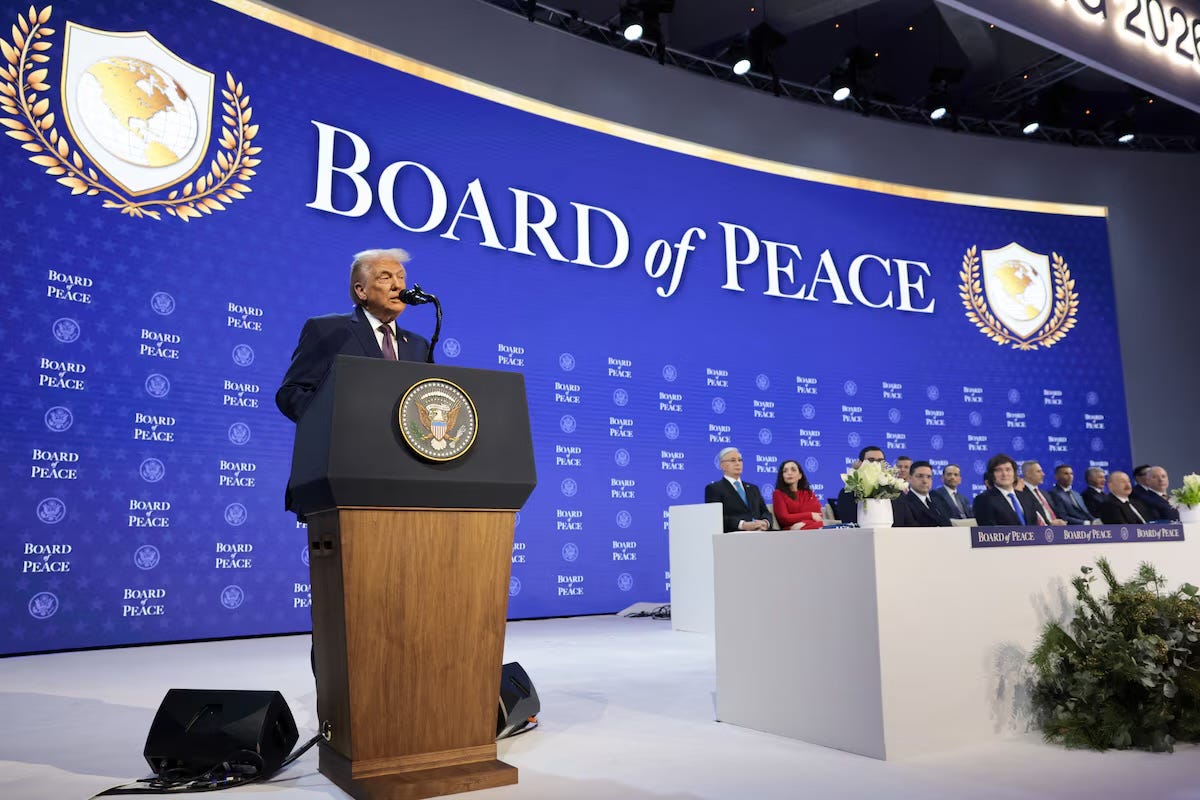
This past month, the Trump administration convened what it branded a “Board of Peace” summit, gathering an embarrassingly sparse number of foreign dignitaries to celebrate the administration’s commitment to global stability. The language was soaring. The staging projected certainty.
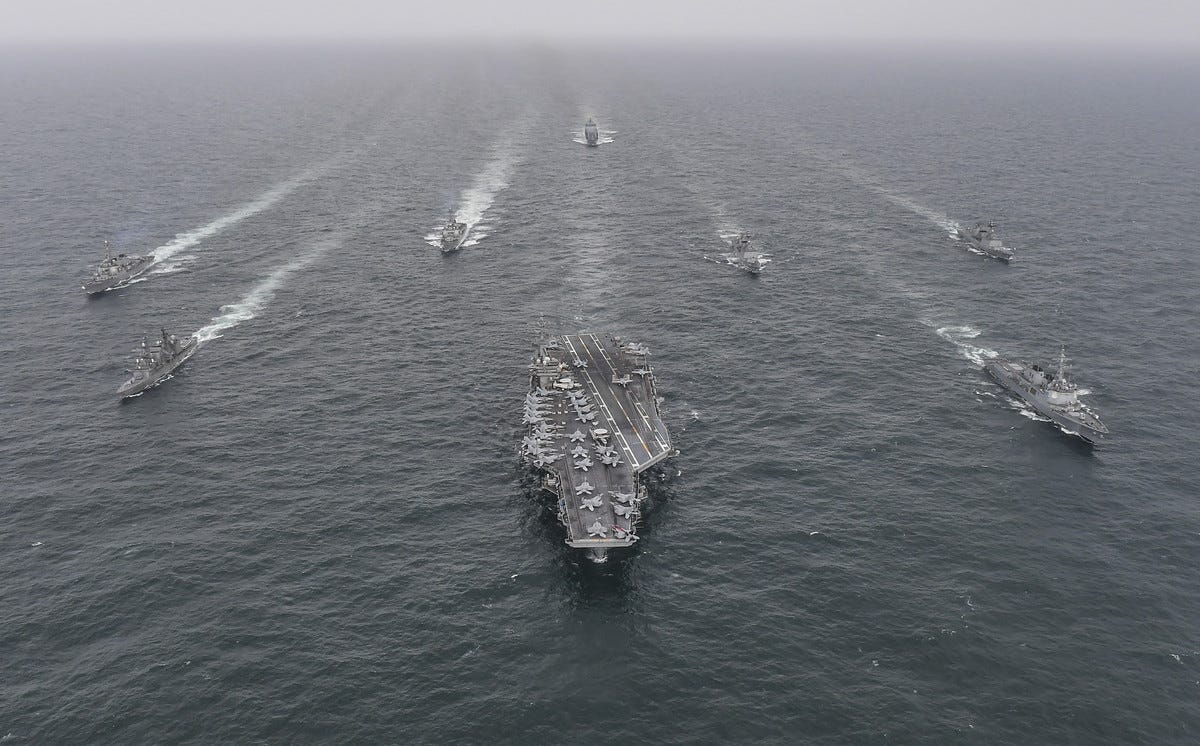
Simultaneously, amidst the photo ops and staged speeches on peace, U.S. carrier strike groups were repositioning toward the Persian Gulf. Pentagon sources were quietly briefing journalists about strike packages targeting Iranian nuclear facilities. The machinery of a military confrontation — target sets, escalation ladders, regional coordination — was being assembled in the background like stagehands building a set while the curtain is still up.
Einstein’s formulation does not require elaboration here. We were quite literally posturing about world peace while simultaneously preparing for war.
And America is preparing for war in virtually every sense. Not just in moving aircraft carriers to attack positions in the middle east. Not just in encouraging and enabling previous bombing raids in Iran. Not just in militarily invading Venezuela to decapitate its political regime. Not just in posturing to invade Greenland for their stuff.
We have literally changed the name of the Department of Defense back to the Department of War after we decided that the mentality that brought us into the largest global conflict in human history needed a change in perspective. In the dawning era of the late 1940’s Cold War, “Defense” sounded more aligned with maintaining peace and deterrence than the more aggressive “War.”
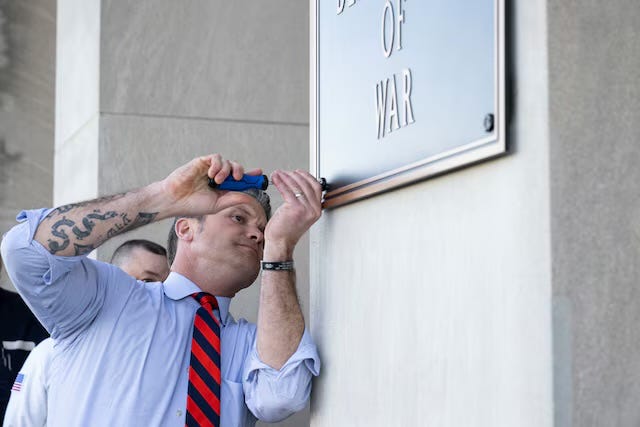
Today we are literally choosing to go back to war.
Trump ran on one of the most explicitly anti-war platforms in modern Republican history. He attacked the Iraq War. He promised to end foreign entanglements. He spoke to a coalition exhausted by two decades of conflict that consumed American lives and treasure while solving nothing. They believed him because he named the machine, as Eisenhower did before him — the defense contractors, the military industrial complex, the Beltway interventionists — and promised to dismantle it.
He is now operating that machine at full capacity. The Washington Post reported this morning that “Trump aides are struggling with how to spend $500 billion more on the military”. Yes, in a time of record debt and deficits we can’t figure out any new ways on how to spend the colossal amount of money we have dedicated to building our war machine.
And so we will casually add Iran to the list of Trumps many broken promises. But understand that this particular broken promise carries a specific and terrible weight, because we are not talking about tariff policy or the size of the deficit. We are talking about a potential military confrontation with a nation that sits at the center of a regional tinderbox, in an era when the escalation pathways from conventional to catastrophic have never been shorter.
Einstein understood this geometry. He lived with the guilt of having helped make it possible. Einstein heard the distant beat of war drums on the horizon that are now presaging war. And not just any war but a war that could spill out into a global conflict. World War III.
Einstein also famously said that he “…did not know with what weapons world war III would be fought, but world war IV will be fought with sticks and stones.”
The atomic era obviously did not make war obsolete. But it did make a global war unthinkable. Or it was supposed to. What it actually produced was a world that talks peace and builds weapons, that holds summits while repositioning fleets, that mistakes activity for wisdom and motion for strategy. You cannot simultaneously prevent and prepare for war. This is not a bumper sticker. It is a warning from a man who helped build the weapon that changed everything, who spent the rest of his life trying to make sure we understood what we were holding.
We are still not listening.
How about "you cannot prepare to prevent voter fraud while preparing to commit voter fraud" . . .
Crazy shit . . .
This administration is also at war with its people for what are war atrocities.
Strength thru brutality is inherently weak and unsustainable.