
Why We Love Punch
A baby monkey, a stuffed orangutan, and the loneliness we recognize in both

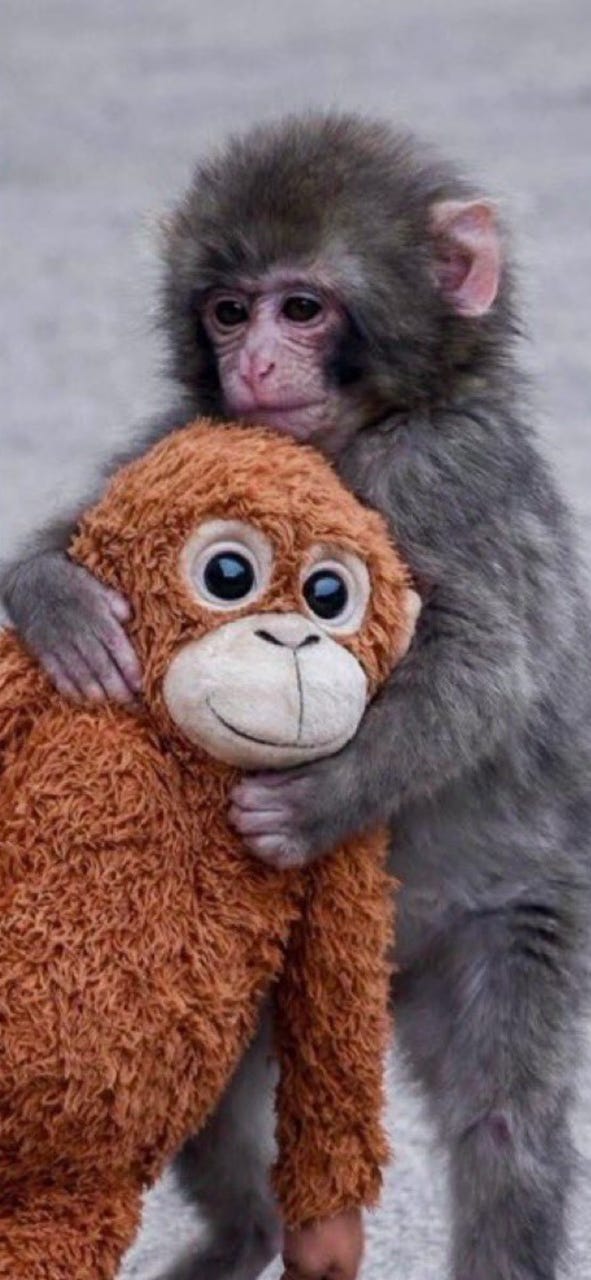
His name is Punch. That’s short for his Japanese name Punch-Kun. By pure coincidence it can be shortened in English to “Punch” and we’re not sure if its because the little monkey the world has fallen in love with can give a punch back to the cruel world that hurts him or if its because he keeps taking them daily with grace and determination.
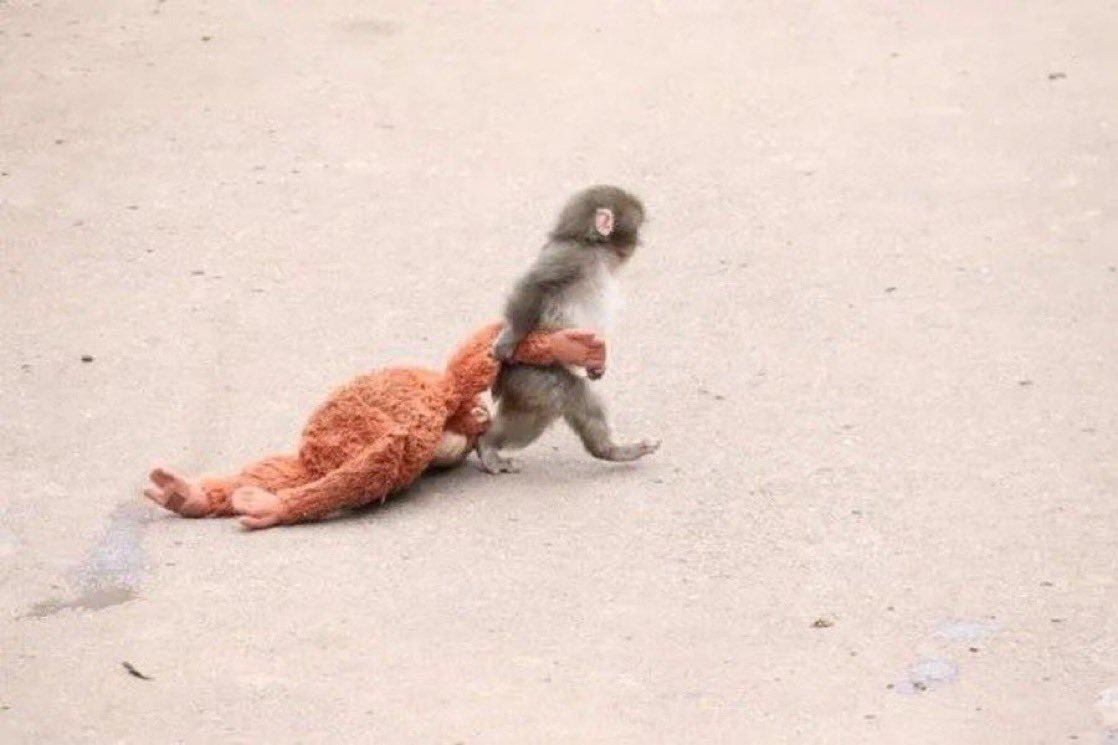
He is seven months old. He weighs less than a bag of groceries, has a face like a tiny old man, and he is dragging a stuffed orangutan across the concrete floor of a Japanese zoo with the kind of fierce, desperate tenderness that makes grown adults cry into their phones on the subway. Or share his travails with co-workers in the breakroom. With our kids. Our neighbors.
But mostly ourselves.
You know about Punch by now. Born July 26, 2025, at the Ichikawa City Zoo outside Tokyo, he entered the world and almost immediately lost it — his mother took one look and walked away, showing what zookeepers delicately described as a “lack of interest in raising him.” The next day, staff began hand-feeding him from a baby bottle. Two caretakers became his world. And when they finally introduced him to Monkey Mountain in January 2026 — sixty macaques, a whole society waiting — Punch arrived in the new world without the one thing young macaques need to navigate it: a mother’s love.
He showed, the zoo said, “signs of anxiety and isolation.”
So they gave him a stuffed toy. An IKEA orangutan, the Djungelskog, fourteen inches tall, $20 retail. Punch adopted it like the mother he never had.
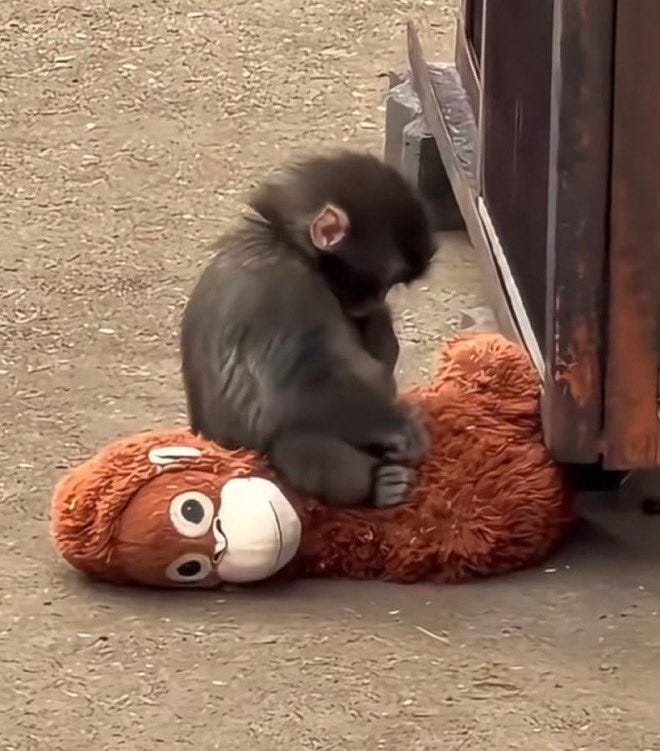
By February, videos of the pair had gone viral across Japan and then the world. Punch sleeping curled around his plush companion. Punch dragging it by one arm across the enclosure. Punch clutching it to his chest after an older monkey shoved him to the ground and spun him in circles, the tiny primate scrambling back to the only thing in his world that has never left him. The hashtag #HangInTherePunch lit up across social media. Thousands lined up outside the zoo. IKEA Japan donated 33 replacement toys and their CEO showed up in person. The stuffed orangutan sold out globally and began fetching $355 on eBay.
The world, in other words, lost its mind over a baby monkey and his doll.
The question worth asking is: why?
The easy answer is that it’s cute. And it is — unbearably so. But cuteness alone doesn’t explain the depth of collective feeling here, the genuine grief people report watching these videos, the protective fury at the older monkeys who shove him around, the hashtag that reads less like internet enthusiasm and more like a prayer.
The world has come to root for a baby monkey alone and abandoned in the world feeling scared, hurt and isolated - completely unaware that he has captured the heart and love of millions around the globe.
I think we love Punch because we recognize something in him that we rarely see articulated this honestly in public life: the specific loneliness of reaching for comfort from something that cannot - or will not - reach back. The pain of loving something but finding it is unable to love us back the way we need.
The stuffed orangutan (fans have named it “Oran-Mama”) cannot love Punch. It cannot groom him, warm him, teach him the elaborate social grammar of macaque life, or protect him when the troop decides to make him the example. It is polyester over recycled fiber. It hangs from his arms because its velcro hands are designed to hang. It is, in every biological and emotional sense, insufficient.
And yet Punch holds on.
There is something in that image, the small creature clutching the inadequate substitute, that cuts through every demographic and cultural barrier the internet usually enforces. Because most of us know that feeling. We have all, at some point, held tight to something that could not hold us back. A habit. A memory. A relationship that ended but whose ghost we kept consulting. A belief, or a love, we maintained past its evidence. The comfort object doesn’t have to be a stuffed toy to be the same transaction: I know this cannot give me what I need, and I am going to hold it anyway, because the alternative is holding nothing.
That’s really what it is - I will hold on to something empty because I can not survive by holding onto nothing at all. Like Punch we hold onto that, drag it along with us, carry it into society unaware that it may be part of why we aren’t welcomed in the first place.
What makes Punch extraordinary, and what the zoo’s keepers have been quietly insisting, even as the world projects tragedy onto him, is that he is not defeated by this. “While Punch is scolded, he shows resilience and mental strength,” the zoo said in a statement that asked the public to support his effort rather than pity his loneliness. Even when knocked down, he recovers quickly. He keeps approaching the troop.
He keeps trying. He punches back. He just also keeps the orangutan close.
And despite it all. The loneliness. The rejection. He still finds moments of joy. Sharing moments with his stuffed toy. Rolling on her the way a toddler does his mother. Running upright with a stick, learning to play alone if no one will play with him.
The zoo reports that Punch has begun forming some connections with the other macaques. The prognosis is uncertain because without a mother to model social behavior, integration is genuinely hard…but he is trying. He is learning. He is doing the terrifying work of seeking belonging in a community that has so far mostly rejected him, armed with nothing but resilience and a fourteen-inch stuffed toy that cannot love him back.
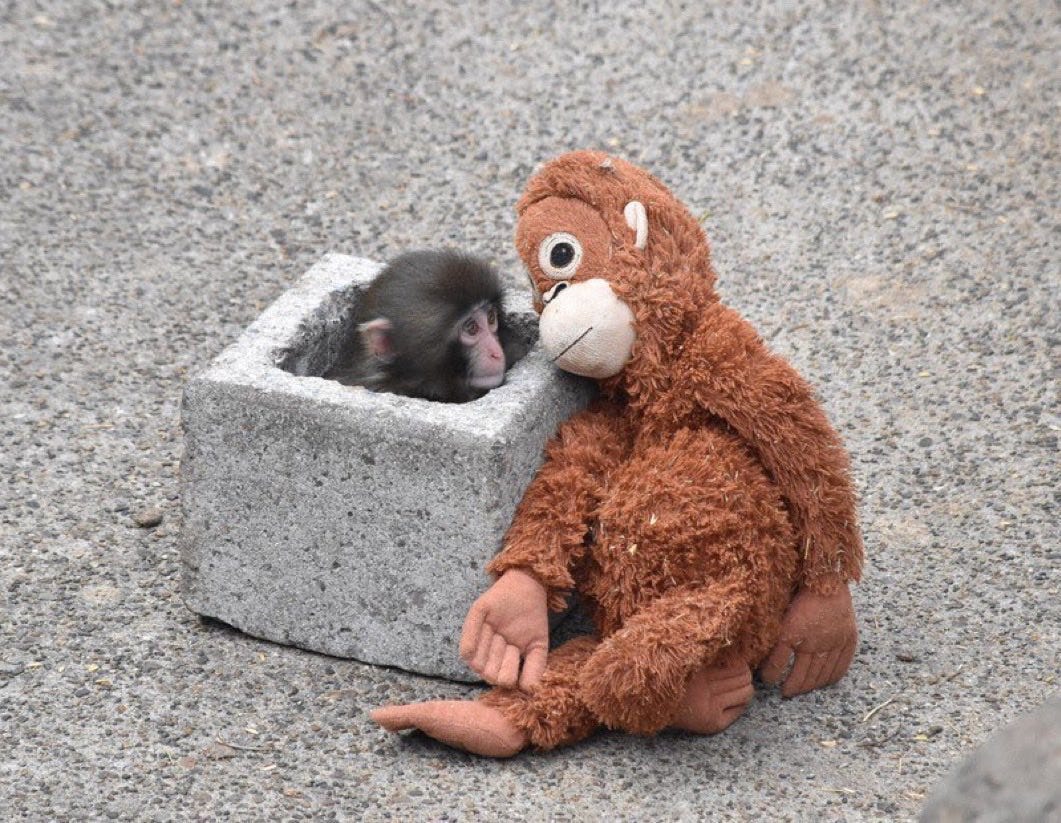
Hang in there. It’s what you say to someone facing something hard, knowing you cannot do it for them. It is how we are not alone in our loneliness. We can see struggle. We can feel it because we’ve been there. It is encouragement as witness.
And the world is witnessing Punch.
Maybe that’s what we’re really doing when we share the videos with friends and with strangers on social media. When we buy the plushie and flood the zoo gates: bearing witness to a small creature doing the most human thing imaginable. Loving what he has. Reaching for what he needs. Getting up again when he’s knocked down. Carrying his comfort object across the concrete floor of the world, dragging it by one arm, heading back toward the troop that has not yet accepted him….and wondering if they ever will.
#HangInTherePunch.
We mean it.
A lonely broken human world really wants you to find love and acceptance.
We need you to.
Mike Madrid writes about politics, culture, and the Latino Century you can see his video essays on YouTube HERE.
Morning, Mike. Thanks for this. You're right - at one point in our lives, we have all known or will know what little Punch is going through.
Some only for a brief moment, some longer than most.
It costs nothing to be kind.
Thanks for this piece and your vulnerable analysis, Mike. My son has been watching ABC World News every night as part of a Boy Scout Merit Badge requirement, and Punch has been the “heartwarming” story at the end of multiple broadcasts. Except I cry every time. I hadn’t stopped to analyze why in this amount of depth, and I really love that not only did you analyze it on a personal level, but also you shared those thoughts publicly.