
The Taco Wars
From Gerald Ford’s corn husk to Del Taco Street tacos and Breakfast Tacos in Texas — a light hearted look at fifty years of politicians who still don’t quite get it

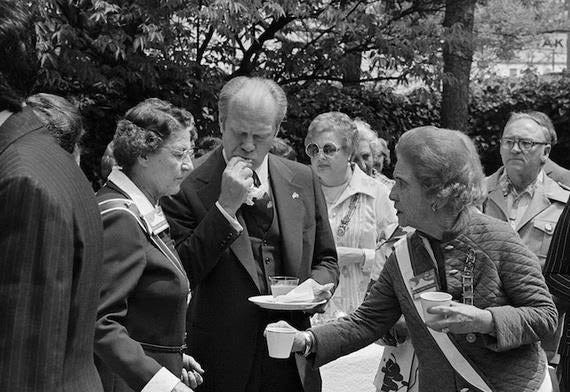
It was April 9, 1976. Gerald Ford, the sitting president of the United States, was in San Antonio, Texas trying to court Latino voters, because even then everyone knew you had to court Latino voters, even if nobody had quite figured out how. Someone handed him a plate of tamales at the Alamo (which is already a lot to unpack - my closest readers know how I feel about the Alamo) and Ford, a man who had played college football and survived World War II and a constitutional crisis, picked one up and bit into it without removing the corn husk.
The mayor of San Antonio, Lila Cockrell, was diplomatic about it afterward. “The president didn’t know any better,” she told the Chronicle. “It was obvious he didn’t get a briefing on the eating of tamales.”
No briefing. On tamales. For a trip to San Antonio.
Mike Huckabee, who lived in Texas at the time, has spent nearly five decades convinced that the corn husk cost Ford the presidency. “Every newscast in Texas all weekend long, all they did was show Gerald Ford not knowing how to eat a tamale. To this day I am convinced that it was that gaffe with the tamale that cost him the state of Texas. Carter won Texas and Carter won the presidency, and it may have been a tamale that did it.”
A tamale. The presidency. Gone.
You would think that story, which has been told and retold for fifty years, which has been whispered about and nearly forgotten in every Latino political consulting handbook you’ve never read but should have, would have taught American politicians something fundamental. You would be wrong. Fifty years later, we have the Taco Wars of 2026, playing out in real time across the two largest Latino-voter states in the country, and I am here to tell you that we have learned approximately nothing.
Let’s set the scene.
In California, Steve Hilton — British-born, naturalized American, former Fox News host, current Republican gubernatorial candidate — posted a video after a campaign stop in Barstow, holding up what he called a “Barstow street taco” and asking the camera, with genuine enthusiasm, why he was holding it. The answer was that he had just purchased it from Del Taco, the fast food chain with around 600 locations across 17 states, at what he described as a “historic location” , the site of the chain’s first restaurant.
The internet assembled immediately to dunk on him.
“You cannot be governor of California if you think a crunchy shell taco is a street taco,” one person posted. My buddy Gustavo Arellano, the LA Times columnist who literally wrote the book on Mexican food in America, could not let it go without comment. He noted that the first Del Taco was actually in Yermo, and concluded simply: “That’s DEFINITELY not a ‘street’ taco.”
Hilton, to his credit, tried to pivot, explaining that he’d visited the location because his running mate Gloria Romero had worked there as a teenager. A sweet story! Also not a street taco!
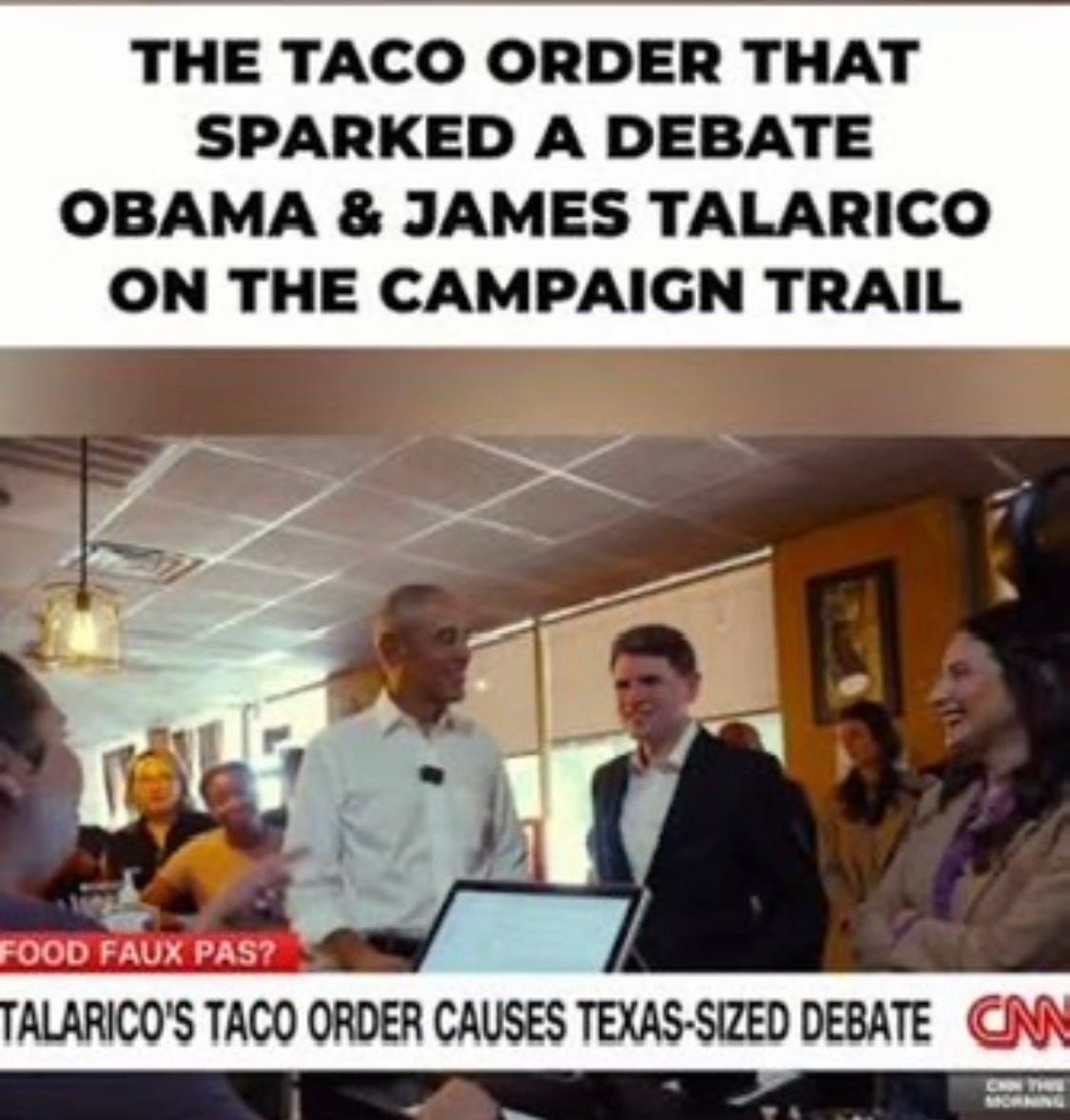
Meanwhile, in Texas, the food-shaming ran in the opposite partisan direction. James Talarico, the Democratic U.S. Senate candidate, showed up at Taco Joint near UT-Austin with Barack Obama and gubernatorial candidate Gina Hinojosa for a Taco Tuesday that became an instant campaign tableau. The cashier, apparently a person of culture and memory, already knew Talarico’s regular: two potato, egg, and cheese breakfast tacos. Lovely! A man who goes to the same taco spot often enough to have a regular order!
I’m not a big fan of the Texas breakfast taco. I think its weird. Breakfast burriots? Well that makes perfect sense but breakfast taco? Its one of those Texas things where Texans try so hard to be different and cool but they’re really just Texans.
MAGA Twitter was not charmed with Talarico’s order. People online called Talarico a “gay vegan” for the potato, egg, and cheese order - a charge that requires you to believe eggs are a vegan food, and that potato breakfast tacos are somehow evidence of coastal elitism rather than what they actually are, which is: a Texas institution eaten by literally millions of Texans every single morning before work.
Now, here is what’s actually funny about all of this, and also what is not funny at all.
The funny part: fifty years after Gerald Ford nearly swallowed a corn husk and potentially handed Jimmy Carter the White House, we have a British Fox News host calling a Taco Bell competitor a street taco, and a Democratic Senate candidate being called a vegan because he ordered eggs. The wheel of political food humiliation spins eternal. There will always be a camera. There will always be a corn husk.
None of this is actually about the food by the way - its about culture and relatability.
It never was about the food. Ford’s tamale wasn’t a gaffe about tamales, it was a gaffe about attention. About whether you bothered to learn, before you showed up, what the thing was and how it worked and what it meant to the people who made it. A street taco is not just a taco served on a street. It’s a specific culinary grammar — soft tortilla, grilled protein (often of the exotic variety…tongue, brains, intestines…), onion, cilantro, salsa — developed over generations in a specific food tradition, available on virtually every block in every major California city, for prices that real people actually pay. Calling a hard-shell Del Taco item a street taco in California is the kind of error that signals you have never actually been in the rooms where the food is. You’ve seen the concept from a distance and assumed proximity was the same as understanding.
That’s a political metaphor so obvious I almost feel bad writing it.
Hilton is asking California’s Latino voters, now the largest voting bloc in the state, the plurality whose families built the agricultural economy and who now represent a huge share of the electorate in every competitive district from the Central Valley to the Inland Empire, to trust him with the governorship. He became an American citizen in 2021. That’s not disqualifying. People arrive here and come to love this place deeply. It’s the whole story of California. But love requires attention. And attention means knowing the difference between what you’re holding and what you say you’re holding. Latinos pounced because an old white guy held a corporate hard shell taco and called it a street taco which was the best way he could say “I’m a Republican born in England and have no understanding of who you are at all.”
The Talarico pile-on is a different species of stupidity. A potato, egg, and cheese breakfast taco is as authentically Texan as a pickup truck, a high school football stadium, and a Sunday church bulletin. The attack on it is pure bad faith — the right-wing content machine scanning for any available marker of difference, any signal that a Democrat is Other, soft, unfit. Kinda like when Obama ordered a hot dog with French mustard. It won’t stick, because it isn’t true. But it reveals the trap that any non-Republican candidate in Texas has to navigate: you will be made to prove you belong in your own state, constantly, on grounds that shift depending on what you ordered for breakfast.
Here’s the thing both incidents share and why I’m writing about the Taco Wars, whuch are about as real and meaningless as the War on Christmas:
Latino voters in California and Texas are finally past the performance stage of connection, what I referred to as ‘sombrero politics’ in my book The Latino Century. Fully, completely, generationally done. They watched decades of politicians show up with a camera and a plate of food and a mariachi band behind them, say the words “Si se puede” approximately fourteen times, and then go govern in ways that had nothing to do with housing costs or school quality or wage growth or any of the things that Latino families — like all families — actually make decisions about.
The voters who swung toward Trump in 2020 and again in 2024 in the Rio Grande Valley and the San Bernardino suburbs weren’t expressing affection for his immigration policy. Many of them have family members directly harmed by it. They were expressing frustration with a Democratic Party that had taken them for granted so long it had stopped even pretending to try. The taco visits, the Cinco de Mayo posts, the Spanish-language ads that aired once on Univision and then never again…all of it registered, over time, as what it was: not engagement, but management. Checking the box on the list of campaign stop necessities.
You cannot manage your way through the 2026 cycle in California or Texas if you are white and your name is on the ballot and you need Latino voters to win. The math is too stark, the margin too thin, and the voters too smart. Steve Hilton needs somewhere in the higher range of a third of the Latino vote to become governor of California. James Talarico needs a substantial share of Texas Latinos to have any shot at the Senate. Neither outcome is achievable through photo opportunities at taco shops.
What it requires — what it has always required, what Gerald Ford’s corn husk was trying to tell us from across fifty years of American political history — is the boring, unglamorous, non-viral work of actually being present. Of being relatable. Not showing up with a camera. Showing up. Knowing the cashier. Having a regular order. Understanding that a street taco and a Del Taco are different things not because of food snobbery but because the difference represents a whole world of knowledge about where people eat, how much it costs, and who made it.
The tamale wasn’t the problem in 1976. The absence of a briefing was the problem. The assumption that showing up was enough. That the gesture would carry the meaning. If you still need a Latino briefing in California or Texas in 2026 you’re not really of this place…not anymore and probably not ever. The Latinization of America means white dominant society is becoming Latino as much as Latinos are melding into the dominant society.
Fifty years later, two candidates in America’s two most important Latino-voter states are proving that the lesson still hasn’t landed. One grabbed the wrong taco. One grabbed the right taco and got roasted for it anyway. And somewhere, Gerald Ford is shaking his head…carefully, because he’s dead, but still.
The corn husk was trying to tell us all something. It still is.
Thanks for a wonderful analysis. I truly appreciate your posts.
I had forgotten about Gerald Ford and the tamale. I do have a modicum of sympathy for him.
I grew up on the East Coast at a time where there were very few Mexican American residents. I was used to Caribbean, Central American, and South American tamales.
I moved to Arizona in my mid 20s. I didn’t realize these tamales were wrapped in cornhusks. I couldn’t understand why they were so tough as I tried to cut them.
It took me years to live down that story.
Love your post!